An attraction’s visit begins before its gate and continues after the photograph. Buses, luggage and the streets around it carry the practical work of receiving people. In Kyoto, those same spaces also carry residents, deliveries and ordinary journeys across the city. Visitor management has to account for that overlap. A quieter route to a celebrated place is valuable when it lets the surrounding neighborhood keep working, rather than simply moving the crowd beyond the frame.
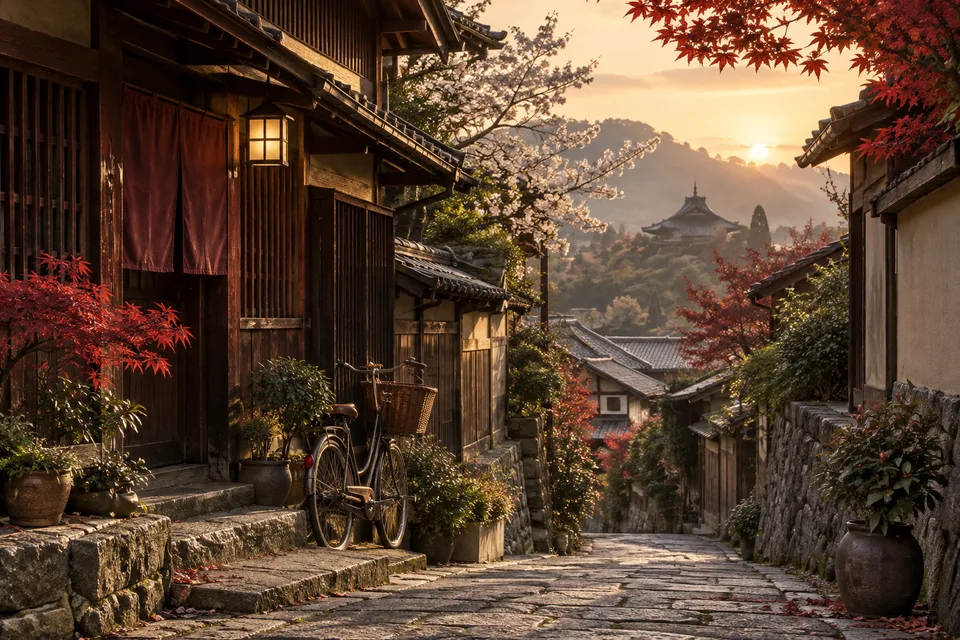
Kyoto’s challenge is particularly visible because the city is so often sold through a promise of atmosphere: a lane, a wooden façade, a quiet approach to a temple. Those settings are inhabited and worked in. The serenity in the photograph depends on relationships the photograph usually leaves outside its frame.
On 2 October 2026, Kyoto’s official travel site published four visitor guidelines, including concerns about following geiko and maiko, unauthorized photography and obstructed streets. It also reported residents’ anxiety about visitors photographing children. This is not a complaint that cultural tourism exists. It is a concrete description of what happens when a visitor’s expectation of access crosses into somebody else’s daily life.
A façade is not consent
Gion is frequently represented as a visual resource: distinctive buildings, recognizable dress and streets that seem to belong to another time. The representation can encourage a mistaken assumption that whatever makes the image interesting is available for capture.
The message from Southern Gionmachi’s local organizations offers a different account. It asks visitors to respect private property and local restrictions, avoid obstruction and remember that the street also carries vehicles. The message comes from residents and institutions including tea-house, geiko and temple organizations. It should be read as place-specific guidance, not transformed into a claim that all of Gion is closed or all photography across Kyoto is prohibited.
The central issue is permission rather than camera quality. A person working, walking home or taking a child somewhere has not agreed to become part of a visitor’s performance. An attractive building does not turn its threshold into a public entrance. Respecting those boundaries preserves the conditions under which the neighborhood can continue to be more than a set.
That is also a responsibility for the travel industry. A guide, hotel or platform can shape expectations before a visitor reaches the lane. If promotional material offers a fantasy of unrestricted access while a small sign later asks for restraint, the visitor receives conflicting instructions. The institution benefiting from the visit should help resolve that conflict, rather than leave the resident to do it repeatedly.
A successful intervention would therefore be more than a multilingual warning. It would make a legitimate alternative understandable: where a cultural performance or visit is offered, which spaces are public and how to recognize local restrictions. Better information should support an appropriate encounter, not merely threaten a penalty after an inappropriate one.
The bus is carrying a city, not an itinerary
A route connecting major sights may also carry people with appointments and work. The visitor can sometimes alter the day; the resident may have much less flexibility. Congestion on that route is therefore a question of shared service, not simply an inconvenience to tourism.
Kyoto’s published response about the former bus-only day pass explains an effort to disperse concentrated bus use toward the subway through the combined subway-and-bus pass. The page was published in February 2026 but identifies its response as dating to July 2025 and warns that circumstances can change. It is evidence of the city’s policy reasoning at that time, not a guarantee about every current fare product.
There is also a more targeted transport product. The city’s guide to the sightseeing Limited Express buses describes EX100 serving the Kiyomizu-dera, Gion, Heian-jingu and Ginkaku-ji areas and EX101 serving Kiyomizu-dera. Introduced in June 2024, these make fewer stops for sightseeing journeys, with a published adult single fare of ¥500. They are not an all-day, every-day replacement for ordinary routes: the guide specifies weekends and designated holiday periods. Separating some visitor trips is a different intervention from asking everyone to share a crowded local bus more politely.
The alternative must still be practical. A subway journey is useful when a person can understand the route, make the connection and complete the last segment. A recommendation that looks efficient on a schematic map may be harder with mobility needs, children or heavy luggage. The transport message should connect the whole journey without assuming every user can walk the same distance or manage the same interchange.
Luggage illustrates how a tourism service can improve ordinary movement. Kyoto’s visitor information promotes traveling without large bags while sightseeing. Storage and delivery arrangements can reduce a source of crowding, but their usefulness depends on location, price, opening times and the visitor’s arrival schedule. A slogan about hands-free travel needs an available service behind it.
The measure of success is also broader than a count of bags stored or tickets sold. Did capacity become easier to use at the times and places where residents experienced difficulty? Did a change move the problem to another route? The intervention should be followed through the network rather than judged only at the point where the tourist makes a purchase.
A crowd forecast is an invitation to change a plan
Kyoto’s congestion-forecast service, updated in September 2026 when checked for this article, combines forecasts with selected live camera views. It presents a five-level scale and allows consideration of date, time and weather. It also states that predictions are updated and can change. This is decision support for a visit, not a promise that a place will be empty when someone arrives.
The tool makes time visible. A destination can have very different conditions within one day, so an annual visitor total cannot explain the experience of the most congested interval. A traveler able to adjust timing may obtain a better visit while reducing pressure at the peak.
But the person receiving the forecast needs room to act. An itinerary, reservation or transport connection can constrain the choice. A tool is more useful when hotels, tour operators and attractions leave some flexibility in the schedule, rather than encourage everyone to check the same map after their day has already become fixed.
There is an important distinction between a live view and a forecast. A camera describes a selected place at an observation time. The forecast estimates conditions under stated assumptions. Neither represents the entire district or every route into it. Users should be able to understand the difference without interpreting a technical model.
The privacy trade-off deserves attention as well. Crowding information can be useful while the people in the scene retain legitimate expectations about how they are represented. A public visitor-management tool should collect and publish only what is appropriate to its purpose. More detailed surveillance is not automatically better tourism management.
The Kyoto online tourist information center places congestion information alongside maps, frequently asked questions and hazard information. This packaging is useful: visitors need practical alternatives and context, not simply a red patch telling them that their chosen place is busy.
The hidden gem already has a neighborhood
Dispersal is attractive because it appears to solve crowding without telling people not to come. Encourage a different place, and both the crowded site and the visitor might benefit. The missing question is whether the receiving place wants and can accommodate the attention.
A quieter area may have narrow streets, fewer facilities or a different relationship between private and public space. Calling it undiscovered can erase the people who already use it. A marketing campaign should not treat low visitor numbers as evidence of unused capacity.
This is particularly important when the desired experience is quietness itself. Promoting the quality without managing the scale of attention can undermine what was being offered. The answer is not to prohibit all discovery, but to work with local institutions on the form, timing and extent of visits.
The same reasoning applies to early-morning recommendations. Moving a visitor away from a midday peak can be helpful, but not every residential route benefits from activity at an earlier hour. The relevant location, conduct and local rules remain important. Time dispersal is an intervention in someone else’s timetable as well as an improvement in the visitor’s.
An appropriate dispersal strategy would therefore assess the destination and connecting route, consult the people receiving the change and monitor what follows. It would offer an account of local benefit beyond a projected rise in visitor spending. A neighborhood’s role is not to serve as a pressure valve without a say in how it opens.
Revenue buys capacity only when it reaches the problem
Kyoto changed its accommodation-tax bands from 1 March 2026. The city’s official information sets out a tiered per-person, per-night structure based on accommodation charges. The existence of that revenue mechanism is distinct from evidence that a particular street or bus route has already improved. The rate depends on the accommodation charge for each person and night, rather than a simple flat levy on each room.
A visitor levy can help fund public services, but the public account should explain the connection between money and outcome. What capacity is added, where is nuisance reduced and what support reaches affected neighborhoods? A larger receipt is not a complete measure of sustainable tourism any more than a larger visitor count is.
Day visitors also use infrastructure without contributing through an overnight tax in the same way. That does not settle how they should be charged or managed. It shows why one revenue instrument cannot represent every relationship between tourism and the city. The funding design and the visitor-management design need to be read together.
Nor can revenue substitute for behavioral boundaries. Paying a tax does not buy consent to photograph someone or permission to enter a private lane. Public-service funding and respect for residents address different obligations. A city should be able to pursue both without implying that one cancels the other.
A useful local feedback process would allow residents to identify recurring locations and times, then show what action followed. Repeated complaints should not have to compete with a rising visitor-satisfaction score to be taken seriously. Equally, a well-targeted response should be assessed against the actual behavior rather than assume every visitor creates the same burden. The specificity is what makes coexistence a workable public task instead of a slogan.
The test is an ordinary journey
Imagine a resident leaving home, walking to a stop and passing through a well-known district. This is a schematic journey, not an interview or a report of a particular morning. The person needs the pavement to remain passable, the transport service to work and the boundary around private life to be legible.
Those needs are compatible with welcoming visitors. They are the conditions under which welcoming can continue without becoming a repeated demand that residents absorb every inconvenience. A destination succeeds when its visitor offer fits the inhabited city, rather than requiring the city to suspend itself around the itinerary.
Kyoto’s tools operate at several points in that relationship: information before arrival, timing choices, transport use, luggage handling and conduct in specific places. Their effectiveness should be assessed at the ordinary journey as well as the famous gate. The quiet street is not spare scenery. It is part of what keeps the cultural city alive.
Sources & context
This article draws on the sources linked in the text. Analysis and illustrative scenarios are identified separately from reported findings.
- four visitor guidelines
- message from Southern Gionmachi's local organizations
- published response about the former bus-only day pass
- guide to the sightseeing Limited Express buses
- congestion-forecast service
- Kyoto online tourist information center
- city's official information